
#7-Bit, Byte, and Beyond: The Language of Data
"Understanding How Digital Information Is Stored, Represented, and Processed."

In this issue of the “VLSI with Ankit” newsletter series, let’s explore what bits and bytes are, why they matter in electronics and computing, and how they form the fundamental building blocks of all digital data.
📌 What’s in a Bit?
At the core of digital systems lies the “bit” — short for “binary digit”. It can be either a 0 or a 1. This tiny unit is the building block of all digital electronics, from simple calculators to advanced VLSI chips.
A nibble is a collection of 4 bits, a byte is a collection of 8 bits. With just one byte, you can represent:
Characters like ‘A’ (01000001 in ASCII)
Numbers up to 255
A color in a grayscale image
📌 Why Bits and Bytes Matter in VLSI
Memory & Storage: All memory systems (RAM, ROM, flash) - work in terms of bits and bytes.
Data Buses: The size of data buses (e.g., 8-bit, 16-bit, 32-bit) defines how much data a chip can handle in one go.
Encoding Logic: Logic gates and combinational circuits interpret and transform bits. Adders, shifters, multiplexers ; all operate at bit level.
Registers & Flip-Flops: These store data in bits and bytes, forming the backbone of sequential circuits.
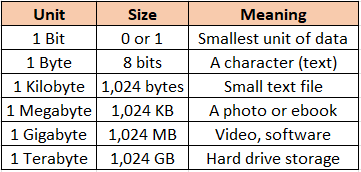
📌 From Bits to Data: How it Scales
📌 Quick Analogy
Bits are like letters.
Bytes are like words.
Kilobytes and Megabytes are like sentences and paragraphs.
Your computer, phone, and VLSI chips are just reading and writing data stories - billions of bits at lightning speed!
📌 Tips for Beginners
Learn binary and hexadecimal conversions.
Understand how characters and data types are encoded (ASCII, Unicode, etc.).
Practice manipulating bits using C/Verilog.
Study how storage elements (SRAM, DRAM) handle bits in hardware.